

This is an old revision of the document!
Electrical Fields and Their Effects
Electrical Basics
The fact that charges exert forces on one another over a distance is explained by the idea of an electric field. An electric field is often referred to as an E-field, because of the symbol used to represent it: $E⇀$. The little arrow over the “E” indicates that the electric field is a vector field—it has both a magnitude and a direction.
Important Points
- Vector fields differ from scalar fields in that scalar fields have a magnitude, but no direction. In fluid systems, for example, pressure is a scalar field. Pressure at a point pushes equally hard in all directions. Flow rate in a fluid, on the other hand, is a vector field— if the fluid is flowing, it has both magnitude (how fast it's going) and a direction (north, south, away from a pump, toward a pump).
- Another example of a vector field is the force applied when you push your car. It has a magnitude—how hard you push, and a direction—out of traffic.
For example, a point charge (a theoretical charge which has zero size1) ) creates an electric field which radiates outward from the charge in all directions. The magnitude of the electric field decreases with distance—the electric field gets weaker the farther you get away from it. Therefore, the electric field of a point charge has a direction which points straight out from the charge, and its magnitude decreases with the distance from the charge2). The magnitude of the field is also dependent upon the strength of the charge—larger charges create stronger electric fields. The electric field induced by a point charge is illustrated in Fig. 1.
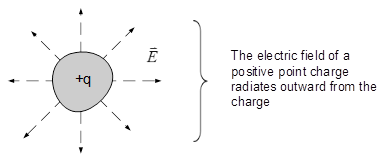
Mathematically, the electric field of a point charge is given, at least approximately, by3):
$\mathord{\buildrel{\lower3pt\hbox{$\scriptscriptstyle\rightharpoonup$}}$
\over E} \infty \hat R\frac{q}{{{R^2}}}