Table of Contents
Ohm's Law
Introduction
Ohm's Law states that the voltage difference across a resistor is proportional to the current through the resistor. The constant of proportionality is the resistance, R. The governing equation is shown to the left below, while a typical symbolic representation of a resistor is shown to the right below.
$$v(t) = R \cdot (t)$$
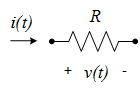
Where v(t) is the voltage across the resistor and i(t) is the current through the resistor. Ohm's law can also be written as:
$i(t) = v(t)R$ or $R = v(t)i(t)$
The last two expressions are just rearrangements of the first.
The units of resistance are ohms (abbreviated Ω). Resistances are commonly on the order of thousands to millions of ohms. Thousands of ohms are represented as kilo-ohms (abbreviated kΩ), while millions of ohms are represented as mega-ohms (abbreviated MΩ). Thus, 10,000Ω can be represented as 10k Ω while 2,000,000Ω can be represented as 2 MΩ.
The direction of the current, i(t), relative to the sign of the voltage difference, v(t), will be important to us later when we begin to analyze circuits mathematically. Note that current is entering the positive voltage node in the above figure. This is known as the passive sign convention. In the passive sign convention, positive current is assumed to enter the positive voltage terminal. We will emphasize this concept later when we start to mathematically model circuits.
Important Points
The important thing to note about Ohm's law is that a resistor's voltage and current through are related by its resistance. As examples, consider the following cases:
- Increasing the voltage across a resistor decreases the current through the resistor, and vice-versa. For example, doubling the voltage across a resistor halves the current through the resistor. A specific example of this case, for a 100Ω resistor, is shown below.

- Increasing the resistance while keeping the voltage across the resistor constant decreases the current. For example, doubling the resistance will halve the current if the voltage is constant. A specific example of this is shown below.

This property of resistors is often useful in circuit design. Many devices can provide only limited current; if your circuit draws too much current from the device, it can malfunction. Increasing the resistance in your circuit may solve this problem.
Test Your Knowledge
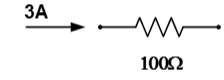
1. What is the voltage across the 100Ω resistor? Indicate the polarity (positive and negative terminals) on the drawing.
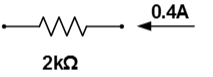
2. What is the voltage across the 2 kΩ resistor? (Note: the “k” prefix stands for “kilo”, or thousands. This is a 2000Ω resistor.) Indicate the polarity (positive and negative terminals) on the drawing.
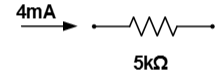
3. What is the voltage across the 5 kΩ resistor? (Note: the “m” prefix stands for “milli”, or thousandths. The current is 0.004A.) Indicate the polarity (positive and negative terminals) on the drawing.
4. What is the resistance, R, of the resistor?
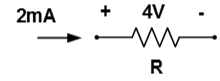
5. What is the resistance, R, of the resistor?
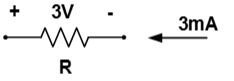
6. What is the current through the resistor? What direction is it in?
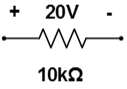
7. What is the current through the resistor? What direction is it in?
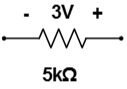
8. What is the current through the resistor? What direction is it in?
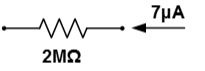
9. What is the voltage across the 2 MΩ resistor? (Note: the “M” prefix stands for “mega”, or millions. The resistance is 2,000,000Ω. Also, the “µ” prefix on current stands for “micro”, or millionths. The current is 7×10⁻⁶A, or 0.000007A.) Indicate the polarity (positive and negative terminals) on the drawing.
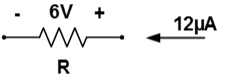
10. What is the resistance of the resistor?
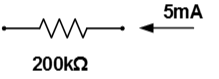
11. What is the voltage across the resistor? Indicate the polarity (positive and negative terminals) on the drawing.
Answers
- (3A)x(100Ω) = 300V. The positive terminal is to the left, and the negative terminal to the right. (It has to obey the passive sign convention, and current is entering the left terminal.)
- (0.4A)x(2000Ω) = 800V. The positive terminal is to the right, and the negative terminal to the left. (It has to obey the passive sign convention, and current is entering the right terminal.)
- (0.004A)x(5000Ω) = 200V. The positive terminal is to the left, and the negative terminal to the right. (It has to obey the passive sign convention, and current is entering the left terminal.)
- (4V)/(0.002A) = 2000Ω.
- Trick question; a resistor cannot have current entering the negative voltage terminal.
- (20V)/(10,000Ω) = 2mA (or 0.002A). Current enters the left terminal. (It has to obey the passive sign convention, and positive voltage is at the left terminal.)
- (3V)/(5,000Ω) = 0.6mA (or 0.0006A). Current enters the right terminal. (It has to obey the passive sign convention, and positive voltage is at the right terminal.)
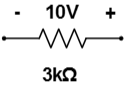
- (10v)/(3,000Ω) = 3mA (or 0.003A). Current enters the right terminal. (It has to obey the passive sign convention, and positive voltage is at the right terminal)
- (0.000007A)x(2,000,000Ω) = 14V. The positive terminal is to the right, and the negative terminal to the left. (It has to obey the passive sign convention, and current is entering the right terminal.)
- (6V)/(0.000012A) = 500,000Ω (or 500 kΩ).
- (200,000Ω)x(0.005A) = 1,000V. The positive terminal is to the right, and the negative terminal to the left. (It has to obey the passive sign convention, and current is entering the right terminal.)